Vertel uw vrienden over dit artikel:
Name letter Branding Bilyk
Besteld in een afgelegen magazijn
 Kerstcadeautjes kunnen tot en met 31 januari worden ingewisseld

Onze klanten zeggen:


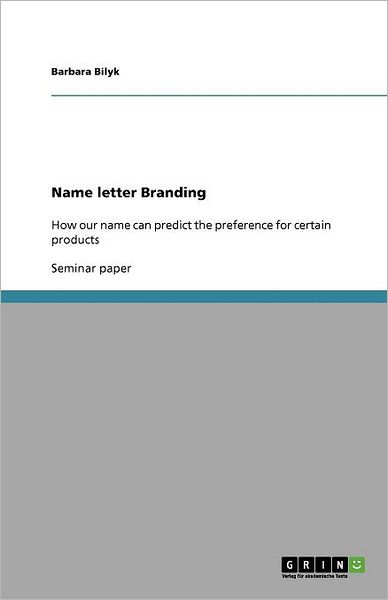
Name letter Branding
Bilyk
Seminar paper from the year 2010 in the subject Business economics - Marketing, Corporate Communication, CRM, Market Research, Social Media, grade: 1,0, University of Cologne (Wirtschafts- und Sozialpsychologisches Institut), course: Consumer Behavior, language: English, abstract: Is it just coincidence that Fabian decided to become a farmer, married Franziska, lives in Frankfurt, prefers Ferrero Küsschen and holds shares of his favourite chocolate producer or was he influenced by the shared name letter (NL)? Although the latter sounds indeed bizarre, prior research has given proof of the fact that people's liking for their own name can affect major life decisions as well as consumption choices (Pelham, Mirenberg, Jones, 2002; Brendl, Chattopadhyay, Pelham, Carvallo, 2005). In the field of consumer behavior it is therefore of high interest to understand the customer's motives for consumption including the influence of specific conditions and moderating factors. The reason for this concern is the overall ambition of marketers to predict consumer preferences in advance and to tailor offers and goods ac-cordingly. While the importance of the marketing tool "brand name" has been recognized in terms of eliciting meanings and forming brand equity for a long time (Wänke, Herrmann, Schaffner 2007), shared letters of consumer and brand name as a trigger for decisions are a comparatively new insight. In this regard two possibile directions of outcomes are conceiv-able. On the one hand consumers might have the tendency to favour brand names including their own name letters, an effect called name letter branding (NLB) (Brendl et al., 2005). On the other hand the reversed effect name letter repulsion (NLR) which is the alientation from a brand name due to shared name letters might occur (Kachersky, 2008). Consequently this pa-per aims at sheding light on the following question: why and how can people's preference for or repelling from brand names be generated by their own name?
| Media | Boeken Book |
| Vrijgegeven | 19 oktober 2010 |
| ISBN13 | 9783640726332 |
| Uitgevers | GRIN Verlag |
| Pagina's | 36 |
| Afmetingen | 138 × 20 × 213 mm · 250 g (Gewicht (geschat)) |
| Taal en grammatica | Duits |
![Cover for Bilyk · Der persönliche Anwendungsbereich (Book) [German edition] (2013)](https://imusic.b-cdn.net/images/item/original/216/9783638665216.jpg?bilyk-2013-der-personliche-anwendungsbereich-book&class=scaled&v=1498398829)
![Cover for Bilyk · Die soziologische Systemtheorie n (Book) [German edition] (2013)](https://imusic.b-cdn.net/images/item/original/343/9783638666343.jpg?bilyk-2013-die-soziologische-systemtheorie-n-book&class=scaled&v=1498467055)
![Cover for Bilyk · Neue Wissensökonomie auf national (Book) [German edition] (2010)](https://imusic.b-cdn.net/images/item/original/503/9783640661503.jpg?bilyk-2010-neue-wissensokonomie-auf-national-book&class=scaled&v=1408400042)
![Cover for Bilyk · Neuheitsgrad als Erfolgsfaktor be (Book) [German edition] (2009)](https://imusic.b-cdn.net/images/item/original/252/9783640396252.jpg?bilyk-2009-neuheitsgrad-als-erfolgsfaktor-be-book&class=scaled&v=1647741897)